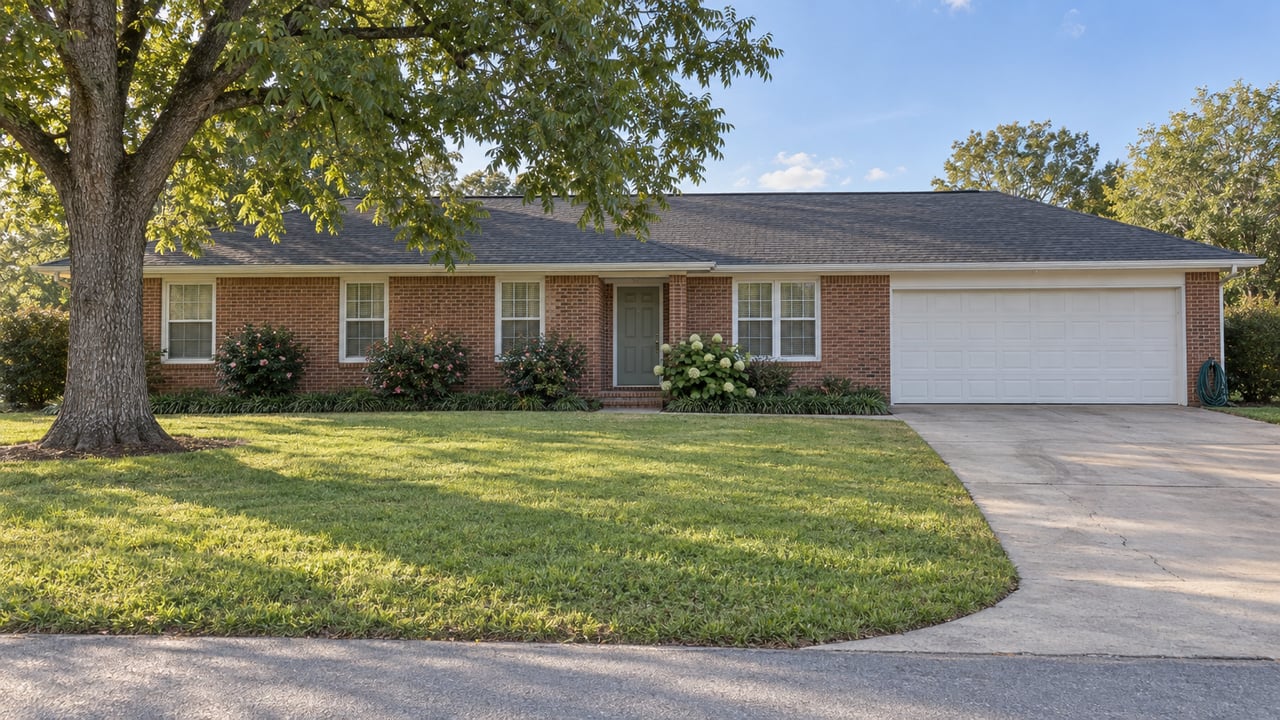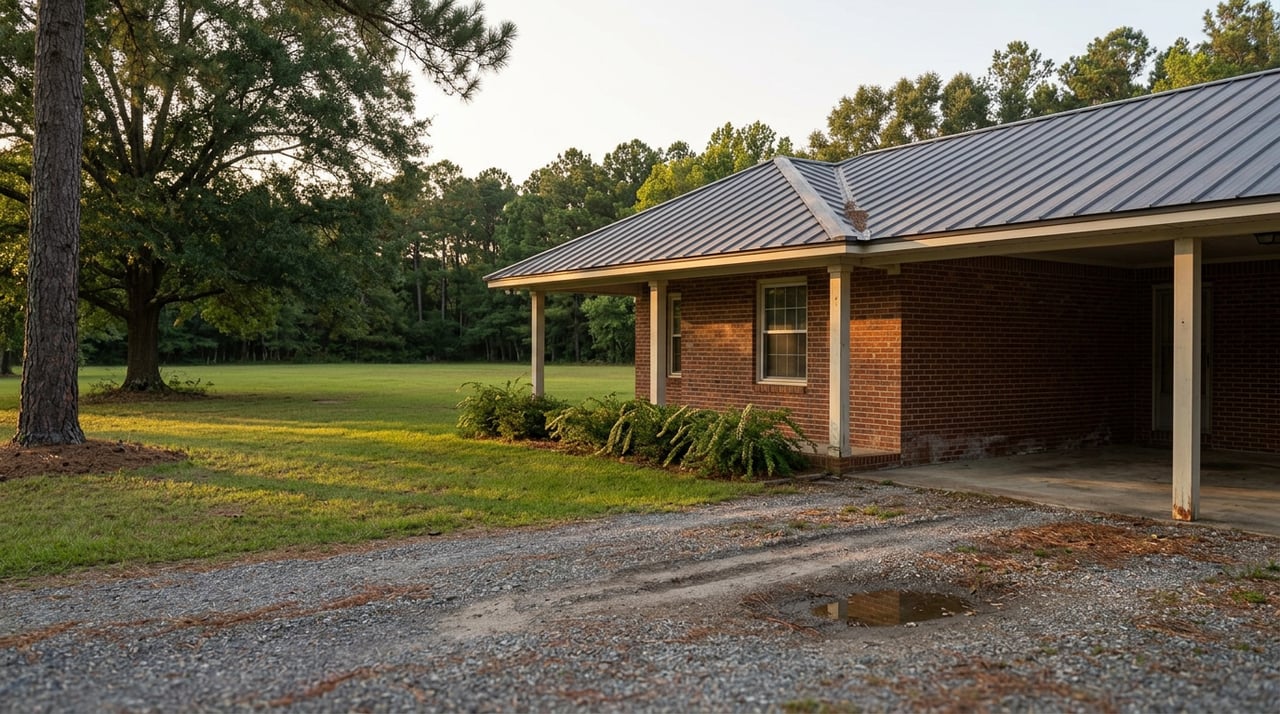
State Line Road runs through Century, Florida before the pavement crosses into Flomaton, Alabama without so much as a stop sign to mark the change. Public sales records show a three-bedroom on the Century side sold for $165,000 in December 2021, while a four-bedroom just across the line in Flomaton sold for $220,000 that same November. The prices were close enough on paper that the state line looked like an afterthought. What a purchase price on either side of that road doesn't tell you is which side costs more to own every year after, and the answer runs backward from what most buyers assume.
Florida advertises a homestead exemption of up to $50,000. Alabama's regular homestead exemption tops out at $4,000 for state taxes and $2,000 for county taxes. Line those numbers up and Alabama looks like the state squeezing homeowners harder. That comparison is the trap. It compares two exemptions measured against two completely different starting points, and once you see how each state actually gets to a tax bill, the story flips.
Two States, Two Different Rulers
Florida assesses a home at 100% of its market value before any exemption applies. Alabama assesses owner-occupied residential property at just 10% of market value, a rate the state calls Class III. So a $350,000 home in Century, Florida starts its tax math from $350,000. The same $350,000 home in unincorporated Escambia County, Alabama starts from $35,000, before any exemption is even applied.
Here's what that produces once each state's own formula runs to the end. On the Florida side, a homesteaded $350,000 home with the standard $50,000 exemption lands near $5,424 a year, an effective rate of 1.55% at Escambia County's 2025 total millage of 17.54 mills. On the Alabama side, that same $350,000 appraised value gets assessed at 10%, or $35,000. The state's regular homestead exemption knocks $4,000 off the assessed value for state tax and $2,000 off for county tax. Using Escambia County, Alabama's own published formula, multiplying the assessed value by the appropriate millage, with the county schedule of state 6.5 mills plus county 28.5 mills, a rural home outside any town's corporate limits works out to roughly $1,142 a year.
Same home value. One state's bill is nearly five times the other's, and the state with the smaller-sounding exemption is the cheaper one.
| Century, FL side | Unincorporated AL side | |
|---|---|---|
| Assessment method | 100% of market value | 10% of market value (Class III) |
| Assessed value on $350,000 home | $350,000 | $35,000 |
| Standard homestead exemption | Up to $50,000 | $4,000 state / $2,000 county |
| Illustrative annual tax | ~$5,424 | ~$1,142 |
The exemption is not the number that matters. The assessment ratio underneath it is.
This is a back-of-envelope comparison built from each county's own published rates, not a quote from either county's tax bill software. City limits, special districts, school board rates, and current-use agricultural valuations all shift the real number in both directions. Anyone weighing a specific parcel should run it through the county's own estimator before writing an offer, not after.
Why Century's Own Numbers Look Deceptively Low
Zoom in on Century itself and the picture gets one more layer. Current county assessment data puts the highest median tax bill among Escambia County, Florida's cities at $4,183 in Gulf Breeze, and the lowest at $705, in Century. That number can read like proof Century is a tax bargain relative to the rest of the county. It mostly reflects home values, not a special break. Century's own 2025 town millage adds a layer on top of the county rate, about 0.92 mills according to the county tax collector's published rate schedule, so the low bill is a function of what homes there are worth, not a lighter hand from the town.
That distinction matters for anyone comparing Century to the Alabama side purely on sticker price. A cheaper home in Century and a similarly priced home in Flomaton are not landing on the same tax curve just because the purchase prices rhyme.
The Deadline Most Buyers Don't Know Is Running
There's a second reason the timing of a Florida purchase near Century matters more this year than most. On June 2, 2026, the Florida Legislature passed the biggest property tax change in state history, HJR 1F, the Save Our Homes from Excessive Property Taxes amendment, which would raise the homestead exemption from $50,000 to $150,000 in 2027 and $250,000 in 2028. It now goes to voters. The amendment goes to voters on November 3, 2026, and requires 60 percent approval to take effect. Most provisions would begin January 1, 2027 if approved.
The exemption expansion applies only to non-school levies. In a significant revision to the Governor's original plan, the House amended HJR 1F so the new exemptions do not apply to school district levies, meaning homeowners would keep paying the school portion of their tax bill, roughly 40 percent of a typical bill. A bigger exemption is coming if voters approve it, but it won't zero out anyone's bill.
The part almost nobody outside a title company reads is the residency clock buried in the bill text. According to the Florida House's own analysis of the legislation, the amendment would create a five-year homestead exemption on the first $50,000 of assessed value of homestead properties, $25,000 for school levies and $50,000 for non-school levies, for owners who are not permanent Florida residents as of December 31, 2026. The state's constitutional initiative summary confirms the same mechanic in plainer language: it requires any person who establishes Florida residency after January 1, 2027 to maintain Florida residency for five years prior to receiving the increased homestead exemption.
Translate that into a calendar. Someone who establishes Florida residency by December 31, 2026 and later buys a homesteaded property is in line for the full expanded exemption on the normal 2027 and 2028 schedule. Someone who moves to Century and claims Florida residency starting in 2027 doesn't get locked out entirely, but they start on a smaller five-year track before the bigger exemption applies to them. For a relocation buyer weighing Century against the Alabama side, that residency date is worth writing on a calendar next to the closing date, not something to research after the fact.
None of this touches Alabama's rules. Alabama's exemption structure and 10% assessment ratio for owner-occupied homes are unaffected by anything happening in Tallahassee. If the amendment passes, it widens the gap between what a Florida homestead exemption is worth and what an Alabama one is worth, but it doesn't change which side of State Line Road runs the lower bill in the near term.
What This Actually Means If You're Deciding Between the Two Sides
If a lower carrying cost is the priority and the home you're comparing sits in unincorporated Escambia County, Alabama, the 10% assessment ratio is doing most of the work in your favor before any exemption is applied. That advantage exists today and doesn't depend on a November vote.
If Florida residency itself is the goal, whether for income tax reasons, family proximity, or simply preference, the November 3, 2026 outcome and the December 31, 2026 residency cutoff are both worth tracking before locking in a closing date. Buyers who can establish Florida residency before the end of this year put themselves on the faster track for whatever exemption voters approve.
Either way, the exemption dollar amount printed on a county's website is not the number to compare across state lines. The assessment ratio behind it is. Pull the actual millage detail for the specific parcel, on either side, before assuming a bigger-sounding exemption means a smaller bill.
A Few Questions Worth Asking Before You Compare
Does the Alabama side have anything similar to Florida's Save Our Homes cap? No. Alabama's system runs on the 10% assessment ratio and periodic reappraisal rather than a value-growth cap. Florida's Save Our Homes cap limits how fast an existing homestead's assessed value can rise, but that cap resets to the purchase price for a new owner, so a buyer's first Florida bill is typically higher than the seller's was.
Is the $1,142 Alabama figure or the $5,424 Florida figure what I'll actually owe? Treat both as illustrations built from each county's own published rates on an identical hypothetical home value, not a specific bill. City mills, special districts, and current-use agricultural classifications can move either number. Run any specific address through the relevant county assessor's tools before making a decision.
Should I wait to see how the November vote turns out? That depends entirely on your own timeline and whether Florida residency matters to you beyond property tax. This isn't tax or legal advice, and anyone weighing the residency cutoff closely should talk to a tax professional who can look at their specific situation.
Comparing two states' tax systems by their exemption size alone is like comparing two recipes by their spiciest ingredient without asking how big the pot is. If you're weighing a home on either side of the line near Century and want a second set of eyes on what a specific address is actually likely to cost to hold, not just to buy, that's the kind of detail worth running down before you write an offer. Kelley Real Estate Co works both sides of this line regularly and can help you get the real numbers for the property you're actually looking at.